
Music
Mazurs, obereks, and other dances from this group are in triple meter and contain the mazurka rhythms consisting of a pattern of two sixteenths followed by two eighth-notes (in a three-eighths meter), i.e. two short and two long notes.
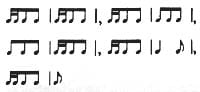
In Polish folk music the basic pattern is derived from 8-, 7- or 6- syllable verses of the mazur folk song; the strophes are structured regularly and consist of four verses set in eight measures of the music. (The pattern of eight measures in three-eighths meter is reproduced on the left, with the beginning of the next system marked at the left, in the third line).
In the music, strong accents are irregularly placed on the second or third beat of the measure. There is also a marked tendency to end the phrase on the dominant pitch located on an unaccented third beat in the measure. The tempi vary greatly between the various types of the dance, and also geographically (the dances are faster in southern Poland than in the northern part of the country). The oberek or obertas is usually the fastest, with MM=160-180; while the regular mazur is performed in the tempo range of MM = 120-40 (the kujawiak is still slower).
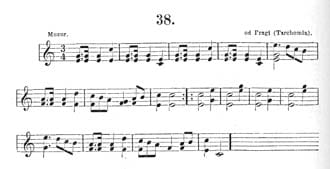
The music consists of two or four parts, each part having six or eight bars, and each part is repeated. According to Helena Windakiewiczowa, the mazurka also has a melodic structure based on such schemes as AABB, AABC, AAAB or ABBB. The accompaniment to the earliest mazurkas was played on the dudy, i.e. a folk bagpipe, which produced either one drone (the tonic) or two (the tonic and dominant).
A singer would then improvise the melody, and sometimes even the text of the couplets, to this stable accompaniment. The most common ensemble performing in the Mazowsze region consists of a violin, a large drum (as depicted below, from the Ethnographic Museum in Warsaw), and later, a Polish folk accordion (with three registers, harmonia trzyrzędowa), and clarinet.

Folk fiddlers often play many variants of the same melody, with different, elaborate ornamentation in each of the variants. There are differences from one part of the region to another, including the areas centered around cities of Płock, Łowicz, Skierniewice, Rawa, and the southern Mazowsze.
In terms of pitch organization, many Polish folksongs, including the mazurka, are modal, in the Lydian mode with a sharpened 4th; the first six notes of this mode were sometimes known as the “Polish mode.”
The introduction of the mazurka to art music is usually credited to Fryderyk Chopin, though his predecessors included Maria Szymanowska, and others. While Chopin’s borrowings from folk, urban, or salon types of the mazurka have been extensively discussed by scholars (e.g. Mieczysław Tomaszewski, Elżbieta Witkowska, Barbara Milewski), certain melodic, harmonic, rhythmic and formal traits point to their close relationship with the idiosyncratic features of the folk mazur-type dances. Several stylized mazurs of the nobility appear in the stage music of Stanisław Moniuszko (operas Halka and Straszny Dwór [The Haunted Manor]). Other Polish composers interested in the mazurka include Aleksander Tansman, Karol Szymanowski, and Roman Maciejewski.
In America, the mazurka (the title was usually in this spelling) appeared in 1840s; salon composers wrote the mazurkas as dances associated with Poland and its celebrated loss of independence, or as fashionable dances dedicated to society ladies. In some variants the mazurka is crossed with the polka – a salon dance, not its folk counterpart. Aleksander Janta lists about 30 mazurkas in his study of nineteenth-century American-Polish music (1982, 128); one publication describes the mazurka as a Russified dance: “The Mazourka is the national dance of Poland, and was introduced into Russia when the Russians subjected Poland. The Russians dance, or rather walk, the Mazourka with a dignified air, but they lack the natural animation and graceful ease adapted by the Poles” (from an 1845 New York edition of A Set of Mazurkas and a Set of Polkas by Coote and Glover).
Sources of Materials
- Burhardt, Stefan. Polonez. Katalog Tematyczny (Polonaise: Thematic catalogue), 3 vols. Kraków: PWM Edition, 1976.
- Dąbrowska, Grażyna. Taniec ludowy na Mazowszu [Folk dance in Mazovia]. Kraków: PWM Edition, 1980.
- Dziewanowska, Ada. Polish Folk Dances & Songs: A Step by Step Guide. New York: Hippocrene Books, 1999.
- Harley, Maria Anna. “Dance as a National Symbol: Polish Dance in Southern California.” Project for Southern California Studies Center at USC, August 2000.
- Janta, Aleksander. A History of Nineteenth Century American-Polish Music. New York: The Kościuszko Foundation, 1982.
- Kolberg, Oskar: Pieśni ludu polskiego [Songs of the Polish people], vol. 1 of Dzieła Wszystkie [Complete Works]. Wrocław-Poznań: Polskie Towarzystwo Ludoznawcze, 1962. Reprint of a 1857 publication.
- “Mazur, mazurek,” entry in Encyklopedia Muzyki PWN. Warszawa: PWN, 1994.
- “Mazurka,” entry in the New Grove Dictionary of Music and Musicians, vol. 11. Stanley Sadie, ed. London: McMillan, 1980.
- Windakiewiczowa, Halina. Wzory polskiej muzyki ludowej w mazurkach Fryderyka Chopina. [Patterns of Polish folk music in F. Chopin’s mazurkas]. Warsaw, 1926.
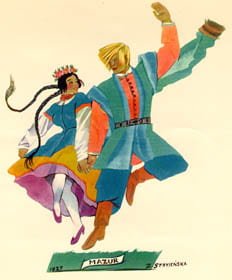
Illustrations from Polish folk art (straw cutouts); Zofia Stryjeńska’s 1927 “Mazur” image; photographs from the PMC Collection and from archival material gathered for M.A. Harley’s Polish Dance in Southern California project.
Dalszy ciąg na następnej stronie
