
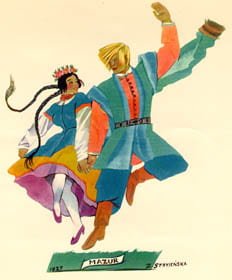

The folk dance is improvisatory in character; it is danced by couples who rotate around the dance hall and present a variety of gestures. As an “exhibition” dance it is regarded as the “most exciting and intricate of the five national dances of Poland” (Ada Dziewanowska: Polish Folk Dances and Songs, p. 509). Dziewanowska described the mazur as filled with contrasts: “it combines the fiery spirit with pride and elegance, vivacity with lyricism, dignity with joy, and boldness with gallantry.”
The position of the body resembles that of the polonaise – head held high, torso erect, graceful motion of the hands. The difference of the character stems primarily from the faster tempo and the presence of irregularly spaced accents, stomps and clicks of the boots. There are four versions of the mazur that could be presented by a folk dance group: the dance of the nobility (in 17th-century costumes), the salon dance of the Napoleonic era (in the appropriate military [men] and salon [women] mixture of clothing), the dance of urban folk or a peasants’ dance from central Poland. Each type of dance would emphasize different class characteristics of portrayed strata of Polish society.
There are a number of basic steps: bieg mazurowy (running step), sideways step, sliding step, and the hołubiec (clicking heels together, similar to the step in the krakowiak). There are also many hand positions, figures, and turns that could be used by couples performing this dance. A different set of group figures is available for ensembles. Thus, the dance leaves much room for the creativity of its choreographer and the spontaneity of individual dancers.
Costumes
Since there are at least four different socio-historical versions of the mazur (17th-century nobility, 19th-century patriotic society, peasants from central Poland, regional varieties from western and south-central Poland, etc.), there are a variety of costumes available for performance.

If the version of the nobility is chosen (at times to music from the classical tradition, e.g. the Mazur from Stanisław Moniuszko’s The Haunted Manor), the clothing should be that of the 17th-century Polish nobility wearing fur-lined jackets (kontusz) and hats. (For more information about this type of costume, see the entry on polonaise). The Polskie Iskry wear a stylization of this costume with women wearing shorter skirts and different shoes that would have been used by the Polish gentry.
The “high-society” mazur may also be performed by the 19th-century Polish legionists (in Napoleonic uniforms, and special square hats bearing the national emblem, an eagle on the front) and their charming partners in Empire gowns, long gloves and at times light, flowing scarves covering their almost-bare shoulders (see polonaise for a more detailed description of this costume).
The folk versions of the mazur, especially from central Poland, could feature the costumes of different regional varieties, for instance the boldly colored, striped skirts and capes of women from the Łowicz area in central Mazowsze, or any other type of the Mazovian costume (of which there are several).
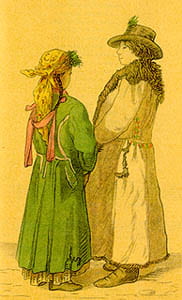
The regional costumes used by Polish folk dance ensembles differ considerably from historically documented clothes worn by peasants from the region in the 19th century, for instance the couple from Raszyn, near Warsaw, as represented in Oskar Kolberg’s Pieśni ludu polskiego (1857).
Nonetheless, the dance groups prefer to present the mazur as the dance of the nobility, reserving the folk costumes for performances of the faster and slower variants, i.e. the oberek and kujawiak. It is also possible to find mazur-type dances in Wielkopolska, Małopolska, or Lubelskie – indeed, with the richness of costumes and the variety of variants available, the mazur truly is a national dance and may appear in suites of dances from all these regions.
Dalszy ciąg na następnej stronie
