
History
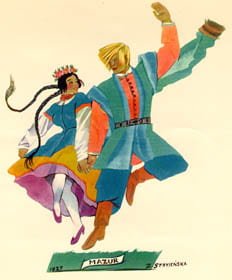
The mazur and mazurek (i.e. small mazur), or in English mazurka, are general terms for a series of Polish folk dances in triple meter, which originated in the plains of Mazovia around Warsaw. The people of the province were called Mazurs; thus, the dance mazur bears the same name as the male inhabitant of the region. The dances, known abroad as mazurkas, comprise more than one type: mazur or mazurek, the obertas or oberek, and the kujawiak from the neighboring district of Kujawy (see PMC entries on oberek and kujawiak). These dances are linked by common rhythmic and choreographic traits, especially the mazurka rhythm discussed below. The name is much younger than the dance itself, and probably originated outside of the region. This term appears for the first time in J. Riepel’s music dictionary published in Germany in 1752.
The dance was known as early as the 16th century; early lute and organ tablatures feature many instances of the mazurka rhythm in pieces entitled Polish dance, or in Latin, Chorea polonica. During the 17th century the dance spread over Poland and began to appear also in neighboring countries; distinct versions of these dances could be found in the repertoire of the countryside (the folk mazur-type dances and the mazur of the nobility), and the towns (urban mazurka).
Augustus II, the Elector of Saxony and King of Poland (1697-1733) was very fond of this dance and introduced it into the courts of Germany. Following Poland’s loss of independence, the dance became fashionable in higher social circles in Paris, then London, and other centers of Western Europe. In 1830, the British paper The Observer (25 April 1830) described the mazurka as “just introduced, or intended to be introduced, into this country.” In the 1830s and 1840s, the mazurka enjoyed its greatest popularity in the Western salons; along with the krakowiak and the polonaise, it served as a sign of solidarity with the oppressed Polish nation, the cause championed by Polish exiles in Paris and their aristocratic patrons. Paradoxically, after the partitions of Poland, the mazurka also became popular among the Russian aristocracy and peasantry.
An important fact in the history of the mazurka is its appearance in the Polish national anthem. Mazurek Dąbrowskiego (Dąbrowski Mazurka) was created in 1797 as a Song of the Polish Legion for the troops of General Jan Dąbrowski, serving Napoleon during his conquest of Europe with the hope of regaining Poland’s independence. The melody of the anthem is of anonymous, folk origin; the text was penned by Józef Wybicki (for more information visit the PMC National Anthems Site). Thus, the fast-paced, energetic dance became a national symbol in several distinct ways.
Dalszy ciąg na następnej stronie
